
Golf Grip Size Guide: Standard vs Midsize vs Jumbo
Fairway Pick may earn a commission from qualifying purchases at no extra cost to you. This guide is editorial research, not a claim that we fit your hands or swing.
Quick answer: start with a grip that lets the middle fingers of your lead hand sit close to the thumb pad without digging hard into it. Standard suits many players, midsize adds roughly one-sixteenth inch of diameter, and jumbo adds more. Hand measurements are a starting point; pressure, pain, release pattern, weather, and the way the installed grip changes club balance decide the useful size.
What grip size changes
The grip is the only part of the club you hold, so its diameter changes how your fingers wrap and how much pressure feels necessary. Too small can encourage squeezing or make the hands feel excessively active. Too large can reduce finger closure and make some players feel they cannot square the face. These are tendencies, not universal ball-flight laws.
Comfort counts. A golfer with arthritis may prefer a larger, softer profile even if a chart suggests standard. Another player may like a smaller lower hand for feedback. Choose the smallest change that solves a real problem rather than treating size as a swing fix.
Standard, midsize, and jumbo compared
| Size | Useful starting point | Trade-off |
|---|---|---|
| Undersize | Smaller hands or players wanting more finger wrap | May encourage excess pressure if it feels thin |
| Standard | Neutral baseline and widest model choice | May be uncomfortable for larger hands or sore joints |
| Midsize | More support without an extreme change | Adds weight and can soften face awareness |
| Jumbo | Very large hands, reduced finger flexion, or a strong comfort preference | Largest weight and balance change |
Use hand fit as a first filter
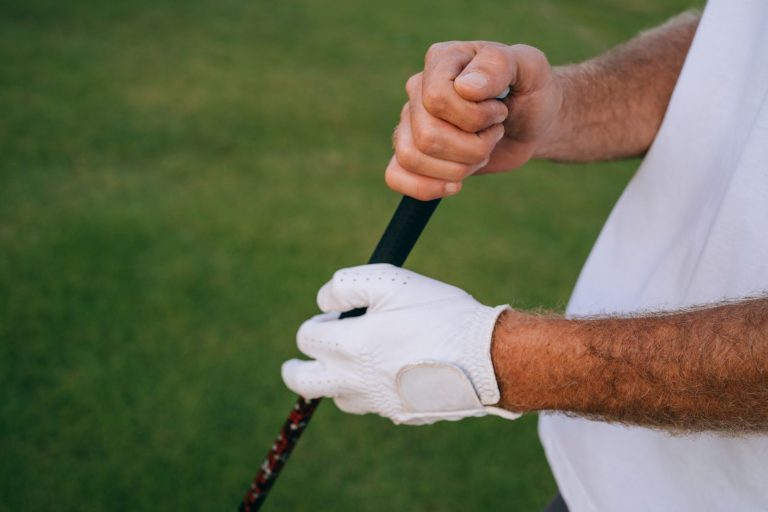
Grip makers publish glove-size and hand-length charts, but brands do not all measure finished diameter in exactly the same way. Install one grip and check the lead hand in a normal address position. The fingertips should approach the heel pad; deep digging suggests too small, while a large gap suggests too large.
Repeat the check with your normal glove. A worn glove, swollen hands on a hot day, or winter rain gloves can change the feel enough to matter. Do not build a permanent decision from one bare-handed shop waggle.
Why taper matters as much as the label
Two midsize grips can feel different because one narrows quickly toward the shaft and another uses a reduced-taper or plus-style lower section. Players who build up the lower hand with extra tape often seek a similar effect: less difference between upper and lower diameter.
Ribbed or reminder grips also change orientation and feel. They must be installed consistently, and adjustable woods complicate alignment because rotating the sleeve can rotate the reminder. Round grips are simpler when settings change frequently.
The inexpensive test that beats guessing
- Choose a mid-iron you know well.
- Install the candidate grip without changing shaft or club length.
- Hit short shots, normal swings, and several tee shots over more than one session.
- Record start line, strike, curve, comfort, and grip pressure rather than only the best shot.
- Compare with a matching club in your current size.
A single range bucket can be misleading because a new grip often feels exciting or strange. Use the test club on the course, where uneven lies and partial shots reveal whether the diameter helps or gets in the way.
Account for weight and swingweight feel
Larger grips often weigh more. Extra weight under the hands can lower the measured swingweight even though total club weight rises. The head may feel lighter, which some golfers enjoy and others dislike. Compare actual gram weights rather than assuming every midsize option changes balance equally.
If you regrip a full set, weigh a sample and ask the installer to keep size, tape, orientation, and stretch consistent. A grip pulled farther down the shaft becomes thinner and can create club-to-club variation.
Texture, firmness, and weather
Diameter cannot compensate for a surface that does not suit your conditions. Cord or aggressive textures can improve traction in sweat and rain but may feel harsh. Softer rubber feels comfortable yet can twist if it becomes wet or worn. Clean grips with the maker’s recommended method and replace them when the surface turns glossy, hard, cracked, or slick.
Players who wear through a glove quickly should first check pressure and grip condition. Buying a larger grip may help comfort, but it does not automatically correct a tension problem.
Common mistakes
- Choosing jumbo because a tour player uses it.
- Using grip size as a guaranteed cure for a hook or slice.
- Comparing labels while ignoring taper and actual diameter.
- Regripping all clubs before testing one.
- Ignoring the heavier grip’s effect on total weight and head feel.
- Mixing installation tape, stretch, and alignment across the set.
Who should consider a fitting
Get hands-on help when pain, limited range of motion, previous injury, or a major swing change is involved. A fitter can build samples with different diameters and weights while keeping the rest of the club stable. For ordinary experimentation, one test club is enough to avoid an expensive set-wide mistake.
Keep notes after the change
For three rounds, note where the ball starts, the common miss, whether grip pressure rises late in the round, and any discomfort. Separate driver, full iron, wedge, and recovery shots because the same diameter can feel helpful in one task and awkward in another. Do not judge from score alone; wind, putting, and course difficulty hide what the grip actually changed.
If the new size is merely unfamiliar, the notes should show comfort and control stabilizing. If contact, face awareness, or pain remains worse, return to the baseline instead of forcing an expensive experiment to work.
FAQ
Can I make a standard grip midsize with tape? Extra build-up tape can increase diameter, but the finished profile depends on tape thickness, layers, grip core, and installation stretch.
Should wedges use the same size? Consistency is the safest baseline. Some players prefer extra lower-hand build-up for partial shots, but test it before changing every wedge.
Do putter grip rules differ? Yes. Equipment rules treat putter grips differently in shape. Check the current Rules of Equipment if competition conformity matters.
When should grips be replaced? When they are slick, hardened, cracked, damaged, or require extra pressure to hold securely. Calendar schedules are less useful than condition and playing volume.
Sources
- USGA, Rules of Equipment, grips.
- Golf Pride, grip sizing overview.