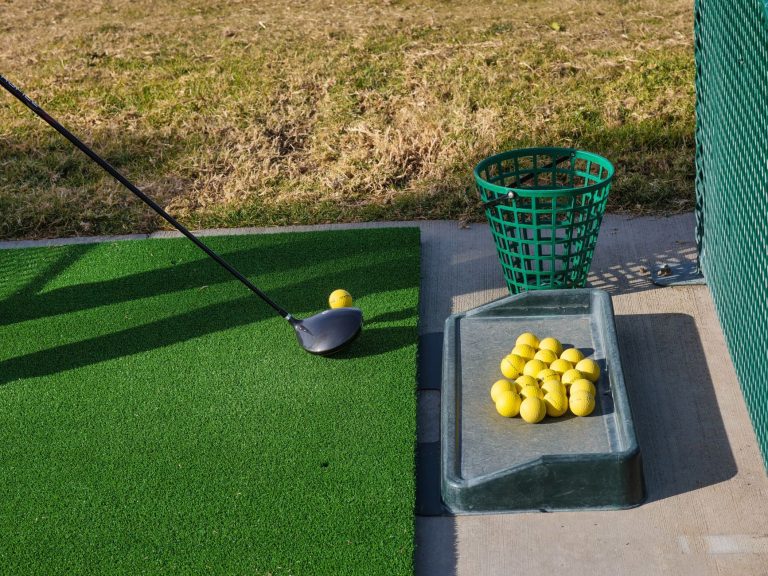

Ball Position in Golf: A Simple Guide for Every Club
Fairway Pick may earn a commission from qualifying purchases at no extra cost to you. This guide is editorial and does not claim a hands-on club test.
Quick answer: For a stock full swing, start wedges and short irons near the middle of your stance, move the ball gradually forward for longer irons and hybrids, place fairway woods forward of center, and set the driver near the inside of your lead heel. Treat that as a baseline, not a law. Your stance width, swing low point, club design, lie, and intended shot can justify a small adjustment.
The ball-position cheat sheet
| Club | Useful starting position | What you are trying to create |
|---|---|---|
| Pitching or gap wedge | Center, or half a ball forward of center | Ball-first contact with a controlled low point |
| 8- or 9-iron | Just forward of center | A descending strike without excessive shaft lean |
| 6- or 7-iron | One to two balls forward of center | Room for the longer club to square before impact |
| Long iron or hybrid | About two balls forward of center | A shallow descending strike and usable launch |
| Fairway wood | Inside the lead heel, but behind driver position | Ball-first or level contact from turf |
| Driver | Near the inside of the lead heel | Contact after the swing reaches its low point |
These references assume a right-handed golfer; reverse lead and trail sides if you play left-handed. The location should be judged relative to your heels, not your toes, because flared feet can make a correct setup look misleading.
Why position changes through the bag
Club length and intended contact change as you move through the set. A short iron is easier to control with the ball near the middle because the golfer wants the club to strike the ball before the turf. A driver is different: the ball is teed up, the club is longest, and most players want the strike to happen later in the arc. Moving the driver forward gives the clubhead more time to reach the ball after the low point.
That does not mean every iron must move one exact ball-width at a time. Some coaches prefer a simple three-position system: one place for wedges and short irons, one for middle and long irons, and one for woods and driver. Others keep the ball almost fixed and change stance width mostly by moving the trail foot. Both approaches can work. The useful system is the one you can reproduce without searching for a perfect inch every time.
Wedges and short irons
Start a stock wedge in the center of a narrow stance. A full pitching-wedge shot can move slightly forward if that helps you turn through the ball, but avoid pushing it so far back that the handle races ahead and the leading edge digs. Back-of-stance wedge positions are shot-making tools for low trajectories; they are not the default cure for inconsistent contact.
For an 8- or 9-iron, use center to one ball forward of center. Check that your sternum is not hanging behind the ball and that your pressure can move into the lead foot. If the ball is too far back, the face can arrive open or the flight can start low and right. Too far forward, and the club may bottom out before impact, producing heavy or thin strikes.
Middle irons, long irons, and hybrids
With a 6- or 7-iron, start one to two balls forward of center. The longer radius needs more time to square, but you still want the low point beyond the ball. A small forward move is enough; placing every middle iron under the lead armpit often turns a simple setup into a hanging-back rescue move.
Long irons and hybrids normally sit farther forward again. Hybrids are designed to replace irons, so do not automatically play them like a driver. From a fairway lie, start about two balls forward of center and make a normal through-the-turf swing. If you sweep upward to help the ball into the air, contact often moves low on the face and loses speed.
Fairway woods
A fairway wood from the turf belongs forward of center but not as far forward as a teed driver. The goal is not to take a deep divot. It is to reach the ball at or just before the bottom of the swing and brush the ground afterward. On a tight lie, moving the ball back half a ball may improve contact; on a fluffy lie, keep it forward enough that the club does not travel underneath the ball.
From a tee, you can move the ball slightly forward and tee it low. The exact location matters less than preserving a balanced setup. If the ball is so far forward that your shoulders open to reach it, the position has already changed your swing.
Driver
Place the driver near the inside of your lead heel, with a wider stance and the trail shoulder lower than the lead shoulder. PGA instruction commonly uses a lead-foot reference for driver setup. That forward position helps many golfers catch the teed ball on the upward side of the arc.
Forward does not mean outside the lead foot. When the ball creeps too far forward, players often slide toward it, leave the face open, or strike the heel. If the driver is too far back, the shoulders may point left and the strike can become steep. Use face spray or impact tape during practice: strike location is more informative than a single launch number.
How to find your repeatable position
- Lay one alignment stick along the target line and another perpendicular to it, pointing at the ball.
- Build your stance around the perpendicular stick instead of shuffling the ball after you are set.
- Hit five stock shots with one club and record contact location, start direction, curve, and turf mark.
- Move the ball only half a ball-width. Hit another five shots without changing your swing thought.
- Keep the position that improves the pattern, not the single best shot.
Repeat the test with a wedge, 7-iron, hybrid, fairway wood, and driver. Those five reference clubs are enough to build a personal system for the rest of the bag.
What common misses can tell you
Fat shots: The ball may be too far forward, but do not move it immediately. First check whether your pressure stayed on the trail foot or your chest stopped turning. Ball position can expose a movement problem without causing it.
Thin shots: A ball too far forward can force a reach; a ball too far back can make you lift to avoid digging. Use the turf mark. If the club enters the ground well behind the ball, fix the low point rather than chasing the ball around your stance.
Pushes: A position that is too far back gives the face less time to close. Pulls: A position too far forward may let the path travel left before contact. Those are clues, not diagnoses, because face angle and swing path still decide the flight.
When to change the baseline
Move the ball back for a deliberately lower flight, a punch under branches, or some uneven lies. Move it slightly forward when you need more launch and the lie supports it. In wind, do not combine a dramatically back ball position with a violent downward hit; that can add spin and make the shot less predictable. Make small changes and keep your finish balanced.
Slopes matter too. On an uphill lie the effective loft increases, so the ball may sit a touch forward. On a downhill lie the effective loft decreases, and a slightly back position can help you meet the slope. In both cases, set your shoulders parallel to the ground and accept the altered trajectory.
Frequently asked questions
Should every iron have a different position?
No. A three-position system is easier for many golfers: short clubs near center, middle/long clubs progressively forward, and woods near the lead heel. Precision matters less than repeatability.
Where should the ball be for a 7-iron?
Start just forward of center, usually one ball-width. Adjust only after checking strike pattern and turf contact.
Is the driver always off the lead heel?
It is a sound baseline, not an absolute. Your stance width and delivery can move the best spot slightly, but extreme positions often create compensations.
Can ball position fix a slice?
Moving it slightly forward may give the face more time to close, but a slice is primarily a face-to-path problem. Use ball position as a setup check, not a substitute for coaching.
Bottom line
Use center for wedges, gradually forward for longer clubs, and near the lead heel for driver. Mark those reference points in practice, test them in small increments, and judge the result by the five-shot pattern. A simple position you can rebuild on the course is better than a theoretically perfect position you cannot find twice.