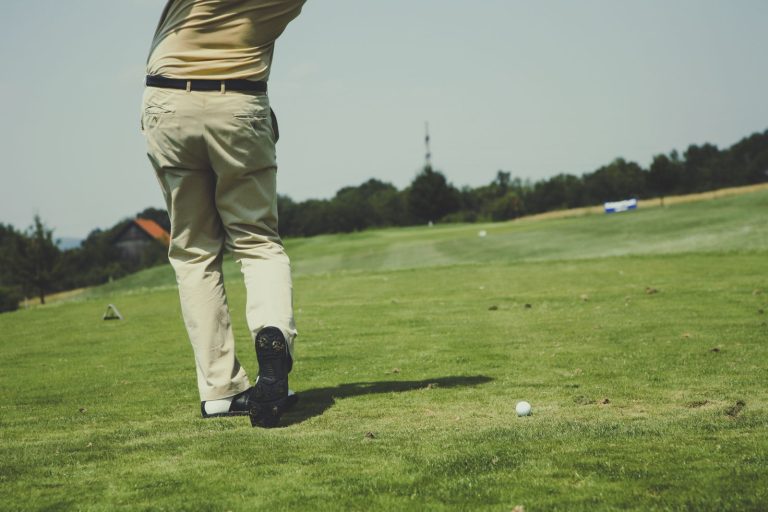

Draw vs Fade: How to Shape Your Golf Shots on Purpose
Fairway Pick may earn a commission from qualifying purchases at no extra cost to you.
Draw vs Fade: How to Shape Your Golf Shots on Purpose
Quick Answer: A draw curves right-to-left (for righties); a fade curves left-to-right. The key to hitting either intentionally is understanding face-to-path—the relationship between your clubface angle and swing path at impact. The clubface determines where the ball starts; the path determines how it curves. Close your stance for a draw, open it for a fade. Both require small setup adjustments, not a swing overhaul.
The difference between a draw vs fade comes down to one fundamental principle: how your clubface angle relates to your swing path at the moment of impact. Most amateur golfers either slice uncontrollably or hook without warning because they don’t understand this relationship. Once you grasp it, shaping shots intentionally moves from mystery to mechanics.
The ball always starts where the clubface is pointing—not where your club is swinging. That’s the first rule. The swing path then determines the curve. Get these two elements working together, and you control the shot shape. Mess up the relationship, and you’ll fight inconsistency for years.
The Face-to-Path Relationship: The Foundation
Think of your clubface and swing path as two separate ingredients. The clubface is the primary cause of sidespin, which makes the ball curve. Here’s how it works:
If the clubface is open to your swing path, you generate slice or fade spin—the ball curves away from your target line.
If the clubface is closed to your swing path, you generate hook or draw spin—the ball curves toward your target line.
This relationship is absolute. You cannot hit a draw with an open clubface or a fade with a closed one, no matter how hard you swing or how perfect your tempo is.
For a draw, your club path needs to be angled slightly to the right of your clubface angle at impact. For a fade, your clubface needs to be slightly open relative to your swing path.
The physics are consistent across all clubs. What changes is how you execute the setup and what adjustments you make during the swing.
How to Hit a Draw Intentionally
A draw is a controlled shot that curves gently from right to left for right-handed golfers. It requires the clubface to be closed relative to your swing path.
Setup for a Draw:
Close your stance by rotating your feet, hips, and shoulders to the right of your target line—just a few degrees is enough. This repositioned stance promotes an in-to-out swing path. Keep your clubface aimed at the actual target, not your stance line. This creates the crucial gap: your path is right, your face is square (or slightly closed). Result: draw spin.
Position the golf ball one inch back from center in your stance. This helps you contact the ball with a slightly descending blow and encourages the closed-face geometry you need.
Execution with Irons:
For iron shots, close your stance, position the ball one inch back from center, and rotate your forearms actively through impact. The forearm rotation helps the clubface stay closed relative to your path. Keep your lower body quiet and let your arms drive the clubface through.
Why This Works:
Draws cut through the wind more effectively than fades. On a dogleg-left hole, a draw is often the optimal shot shape because it curves your ball around the leftward bend and gets you closer to the pin. Even if you miss the draw and hit it straight, you’ll still find the fairway, just further from the hole.
How to Hit a Fade Intentionally
A fade is a controlled shot that curves gently from left to right for right-handed golfers. It’s often considered easier to control because it lands softer with more spin.
Setup for a Fade:
Align your feet, hips, and shoulders 5 to 10 yards left of your target. This alignment creates the out-to-in swing path you need. Aim your clubface directly at the target—the actual target, not your open stance line. This positioning leaves your clubface slightly open relative to your swing path, which generates fade spin.
Position the ball forward in your stance, closer to your lead foot. This encourages a shallow, sweeping contact that pairs well with the fade trajectory.
Execution with Irons:
Open your stance, position the ball forward, and hold the clubface slightly open through impact. Avoid the temptation to rotate your forearms aggressively. Instead, let your body rotation carry the club through, keeping the face aligned slightly open to your path.
Why This Works:
Fades land softer and with more spin than draws, which roll out further. A fade is generally easier to control, making it the preferred shot for precision golfers. The higher backspin and softer landing also make fades more reliable in windy conditions.
Key Trade-Offs Between Draw and Fade
| Characteristic | Draw | Fade | Best For |
|---|---|---|---|
| Ball curve | Right-to-left (RH) | Left-to-right (RH) | — |
| Wind performance | Cuts through wind better | Higher backspin, softer | Windy rounds (fade) |
| Roll distance | More roll, longer distance | Lands softer, shorter | Distance (draw) or control (fade) |
| Difficulty to control | Requires path-face coordination | Slightly easier for most | Higher handicaps (fade setup) |
| Dogleg situations | Ideal for dogleg-left | Ideal for dogleg-right | Hole strategy varies |
| Spin rate | Lower, penetrating flight | Higher, softer landing | Shot type varies |
Common Mistakes to Avoid
Exaggerating the swing path adjustment. Many golfers overdrive the open or closed stance, turning a controlled fade into a slice or a draw into a hook. Keep the stance adjustment subtle—just a few degrees off the target line is enough to change your path.
Ignoring clubface alignment. The most common mistake is letting your clubface follow your stance instead of pointing at the actual target. Your face must remain independent of your stance angle.
Extended lead wrist. If your lead wrist stays too extended at impact, your clubface stays open, and no amount of path adjustment will square it up. You’ll slice every time.
Changing your entire swing. Shot shaping requires small adjustments to setup, not a complete swing overhaul. Beginners often create tension and instability by trying to force a new swing. Adjust your feet, adjust your target aim, adjust your ball position—but keep your swing smooth.
Practicing without purpose. Hit 10 fades without tracking results, and you’ll revert to your natural pattern. Practice with a specific target, immediate feedback, and repetition.
Guidance for 10–25 Handicap Golfers
For most amateur golfers in this range, the priority is a consistent, repeatable swing that produces a relatively straight ball flight. Shot shaping comes later.
Once you can hit solid, predictable shots and control a straight ball flight, you’re ready to experiment with draws and fades. The order matters. Trying to shape shots before you have a reliable foundation will add confusion and frustration.
Key principle for your skill level: Always adjust your setup first, not your swing. Move your feet, adjust your aim, change your ball position. These adjustments are forgiving and repeatable. Swing manipulations are not.
Start with your natural ball flight. If you naturally fade, learn to hit a reliable fade first. Then practice a draw as your secondary shape. Building mastery of one shape before learning the other creates better consistency and confidence.
Equipment: Draw-Biased Drivers
Modern draw-biased drivers use up to five engineering mechanisms to promote draw spin: heel-weighted center of gravity, closed face angle, upright lie, hosel offset, and deep center of gravity for faster closure. Most models combine several simultaneously.
By moving the center of gravity toward the heel, offset design promotes a closed clubface at impact, counteracting the slice tendency and producing a straighter, more controlled ball flight. The downside: moving the CG toward the heel reduces moment of inertia (forgiveness on off-center hits), a trade-off confirmed across multiple years of independent testing.
Draw-biased drivers are built to help golfers square the face more easily, shift launch direction left, and convert a frustrating fade into a playable draw. If you struggle with an open clubface, equipment designed for draw bias can reduce the setup and swing adjustments you need to make.
Bottom Line
Understanding the draw vs fade distinction starts with face-to-path. The clubface determines where your ball starts; the path determines how it curves. To hit a draw, close your stance, keep the face square to target, and let the path difference create the curve. To hit a fade, open your stance, aim the face at target, and let the path difference create the opposite curve.
For 10–25 handicap golfers, master a straight shot first, then build one reliable shape. Use setup adjustments, not swing manipulations. Practice with intention, track results, and let small adjustments compound into consistency. Shot shaping isn’t magic—it’s mechanics. Once you own the mechanics, your game gets sharper and more strategic.
Frequently Asked Questions
What’s the difference between a draw and a hook?
A draw is a controlled, intentional curve (typically 5–15 yards). A hook is an exaggerated, unintended curve that moves too much and lands offline. Both use closed clubface geometry, but a draw is repeatable and strategic; a hook is a miss-hit.
Can I hit a draw with my irons if I naturally fade?
Yes. Close your stance, position the ball back an inch, and rotate your forearms through impact. The setup change is more important than the swing change. Start with short irons (8, 9, PW) to build confidence before moving to longer clubs.
Why do golfers say fades are easier to control?
Fades produce higher backspin and a softer landing, which means the ball stops more quickly and predictably. Draws roll out further, introducing variables. For precision shots into greens, the fade’s softer landing is often preferred.
Do I need a draw-biased driver to hit a draw?
No. A standard driver will produce a draw if your clubface is closed to your swing path. Draw-biased drivers just make the geometry easier by shifting the center of gravity toward the heel. It’s an aid, not a requirement.
Should I practice draws and fades before I can hit straight shots?
No. Develop a consistent, straight ball flight first. Once you can control your natural shot shape, add draws or fades as secondary options. Trying to shape shots too early introduces unnecessary complexity and confusion.