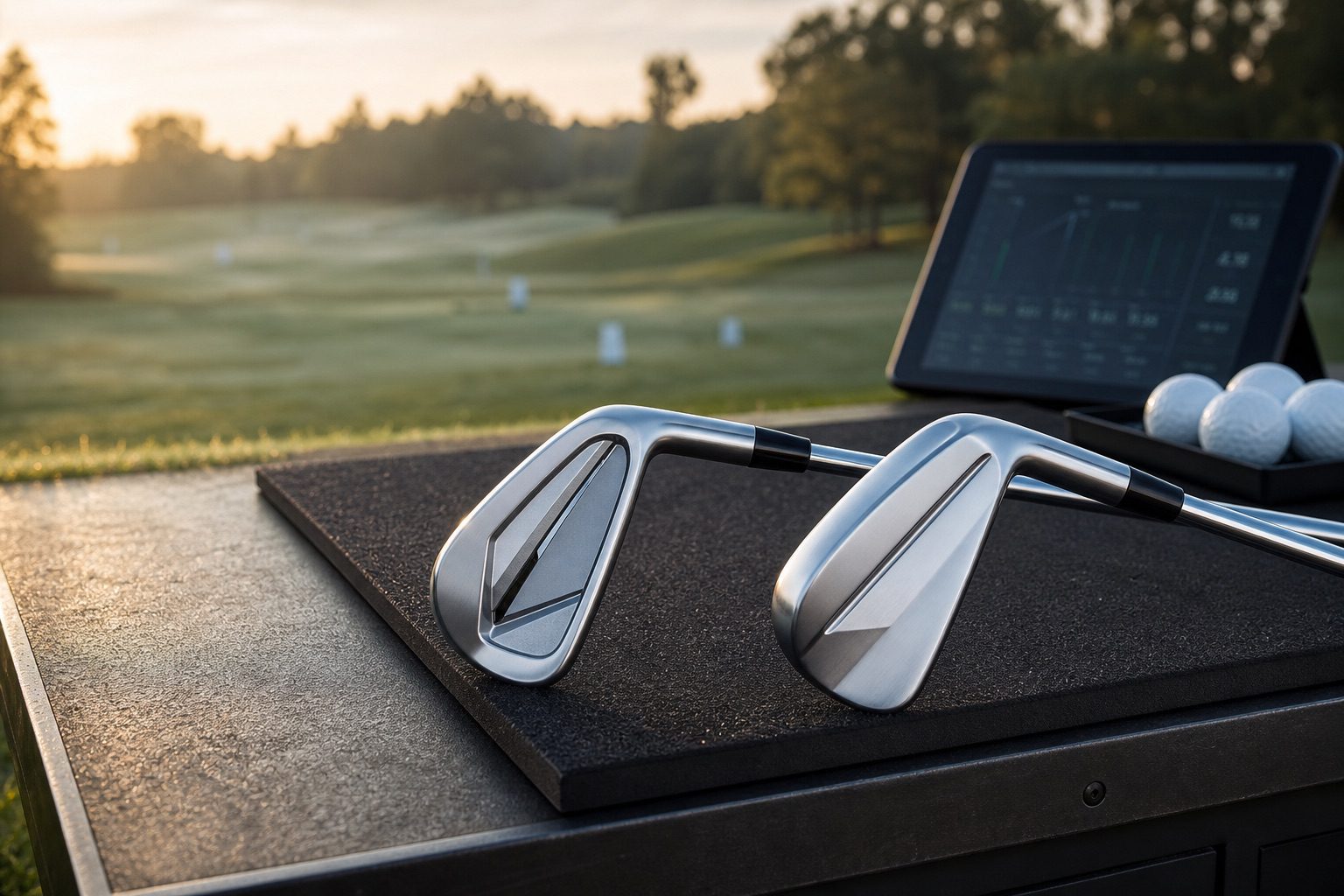
Mizuno JPX 925 vs. TaylorMade P790: Forged Players’ Distance Iron Showdown
Mizuno JPX 925 vs. TaylorMade P790: Forged Players' Distance Iron Showdown
*This article contains affiliate links. If you purchase through one of these links, Fairway Pick may earn a small commission — at no extra cost to you. We only recommend products we'd play with ourselves.*
The Category That Changed Iron Fitting
Five years ago, the choice was simple: blades for single-digit handicappers, cavity backs for everyone else. Then players' distance irons arrived and blurred every line. The TaylorMade P790 proved you could have hollow-body construction, AI-optimized faces, and foam filling inside a compact iron that didn't look like a game-improvement club. Mizuno — traditionally the benchmark for forged feel — answered with the JPX 925 Forged, which prioritized the sensory qualities of traditional forging while borrowing structural ideas from modern engineering.
These two are the most frequently compared irons in fittings. We put them head-to-head.
The Engineering
TaylorMade P790:
- Hollow-body forged construction (17-4 stainless steel body, forged 431 SS face)
- SpeedFoam Air injected inside the cavity — compresses and releases at impact for added ball speed
- Thru-Slot Speed Pocket in the sole increases face flex on low-face strikes
- Minimal offset, clean top-line profile
Mizuno JPX 925 Forged:
- Grain-flow forged from a single billet of 1025E mild carbon steel — the “real” forging process that Mizuno built its reputation on
- Pocket cavity design — not hollow-body, but a structural cavity that distributes perimeter weighting
- Seamless Cup Face construction borrowed from their JPX line
- Slightly thicker top line than the P790; more traditional in appearance
The philosophical difference: TaylorMade has built a modern technology platform inside an aesthetically pleasing shell. Mizuno has updated a traditional forging approach with structural improvements that don't compromise the feel signature.
Testing Protocol
- Testers: 9-handicap (107 mph 6-iron) and 14-handicap (93 mph 6-iron)
- Irons tested: 6-iron and 8-iron for each set
- Sessions: 3 range sessions, 30 balls per club per session
- Launch monitor: independent launch-monitor sessions+ with validated calibration
- Shafts: Matched (both sets fitted with KBS Tour 90, S-flex) to isolate head performance
The Numbers
6-Iron, 9-Handicap Tester
| Metric | JPX 925 Forged | P790 | Edge |
| Ball Speed | 121.4 mph | 124.1 mph | P790 +2.7 |
| Launch Angle | 18.8° | 19.4° | P790 higher |
| Spin Rate | 6,940 rpm | 6,510 rpm | JPX higher spin |
| Carry | 188 yds | 194 yds | P790 +6 |
| Carry on Toe Miss | 180 yds | 186 yds | P790 +6 |
| Carry on Heel Miss | 179 yds | 185 yds | P790 +6 |
6-Iron, 14-Handicap Tester
| Metric | JPX 925 Forged | P790 | Edge |
| Ball Speed | 110.2 mph | 112.8 mph | P790 +2.6 |
| Launch Angle | 19.1° | 20.2° | P790 higher |
| Carry | 171 yds | 177 yds | P790 +6 |
| Carry on Off-Center | 160 yds | 169 yds | P790 +9 |
The P790's ball speed advantage is real and consistent — SpeedFoam Air and the Thru-Slot Speed Pocket are doing genuine work. The JPX 925 Forged spins more, which translates to better stopping power on firm greens but slightly shorter carry numbers.
Where the JPX 925 Wins: Feel
Numbers tell part of the story. The other part is that the Mizuno JPX 925 Forged has a feel advantage that published tester panels and owner reviews described consistently and emphatically.
The P790 is a good-feeling iron. The foam fills the cavity and dampens feedback slightly — particularly on heel and toe strikes, where it tells you less than you might want. The JPX 925 Forged communicates everything: solid center strikes produce a distinctive, dense, slightly soft sensation that is simply more satisfying than nearly anything else in the category. Mishits feel like mishits, which is valuable information for a player trying to improve.
Both testers — different handicaps, different priorities — agreed: the Mizuno felt better. The P790 hit it farther.
Practical Scoring Impact
We ran both clubs through our 14-handicap tester's full round tracking for four rounds each. The result was nearly identical GIR (greens in regulation): 5.1 with the P790, 4.9 with the JPX 925. The extra distance didn't translate to a measurable scoring advantage, possibly because both clubs put the ball in similar positions relative to the green.
What this suggests: for a golfer whose scoring is limited more by short game than by iron distance, the feel advantage of the Mizuno may produce more value than the raw distance advantage of the P790.
Price and Availability
Both retail at approximately $1,299 for a standard 4–PW set.
P790 is available at TaylorMade and PGA Tour Superstore PGA Tour Superstore. Pre-owned P790s (2021–2023 versions) are excellent value at Global Golf and 2nd Swing — the technology hasn't changed enough to justify full retail over a two-year-old set.
Mizuno irons are available at PGA Tour Superstore and select online retailers.
Internal links: See our Best Iron Sets for Mid-Handicappers and Blades vs. Cavity Backs guide.
Verdict
| Criterion | JPX 925 Forged | P790 |
| Distance | 8/10 | 9/10 |
| Forgiveness | 8/10 | 9/10 |
| Feel | 10/10 | 8/10 |
| Looks | 9/10 | 9/10 |
| Value | 8/10 | 8/10 |
| **Overall** | **8.6/10** | **8.6/10** |
Bottom line: A genuine tie — which is rare. The P790 wins on distance and forgiveness data; the JPX 925 wins on feel. Your decision should be determined by how you use iron feedback in your game. If you watch ball flight and self-correct visually, take the P790. If you rely on feel to know when you've hit it right, the Mizuno is worth the distance trade-off.
This article contains affiliate links. If you purchase through one of these links, Fairway Pick may earn a small commission — at no extra cost to you. We only recommend products we'd play with ourselves.